
Contents
To fulfil specific roles in the retail energy market, organisations must become Qualified. This can involve Qualifying as a Party in a specific Party Category e.g., Supplier, Distribution Network Operator, Gas Transporter, Metering Equipment Manager (MEM), Approved Meter Installer (AMI), or Electricity Metering Operative (EMO); or to enable access to a specific REC Service, which is referred to as a Non-Party REC Service User. Once Qualified, these organisations will be able to access the services governed by the REC and have obligations to meet under this code.
For more information on the different areas of the REC Entry Assessment Process for both Parties and non-Parties, please see the Entry and Exit User Guide.
REC Party Entry Assessment Overview
The Entry Assessment Information Pack provides an overview of the market entry assessment process that REC Parties will have to follow in order to qualify to enter the market. This will differ depending on the role each REC Party has in the market. A summary of this information is set out in the pages below, and the Information Pack can be found here.
REC Party Guidance – (Not including Metering)
In order to enter the market, REC Parties have to complete certain stages of the process. The Entry Assessment Forms document detail what RECCo requires from the applicant at different stages of the process. It also includes any supporting evidence (if required) that should be provided when filling in the different self-assessment forms. For more information, please see the Entry Assessment Forms here.
REC Party Assessment Forms – (Not including Metering)
This section details the key documents that are used in the Assessment Process for REC Parties. For these Parties, they will have to complete the following assessments: Business Solution Assessment, Internal Testing, External Testing (is conducted live with the Code Manager via an online medium) and an Information Security and Data Protection Assessment.
Business Solution Assessment (BSA)
The Business Solution Assessment is used to evaluate the applicant’s business and technical solutions. It should be filled in using the guidance from the Entry Assessment Forms document and is used as the basis for Internal Testing. The Business Solution Assessment can be found here.
Internal Testing
The Internal Testing Assessment involves running tests to demonstrate your systems and process can operate against a defined list of market scenarios, as part of the conclusion of the Business Solution Assessment. The market scenarios you need to test will be defined using a risk-based approach depending on the answers to your BSA. The full list of market scenarios is defined in the REC Internal Testing Guidance Including Market Scenarios document which can be found here.
Information Security and Data Protection Assessment
The information Security and Data Protection Assessment (ISDP) is required in order for the applicant to gain access to the REC Services. It is the assessment of the Information Security Environment of the applicant. This has to be completed before an entrant can get access to the REC Services. It should also be filled out using the Entry Assessment Forms document. The ISDP can be found on the REC Portal here.
External Testing
The External Testing stage involves the applicant running tests, in conjunction with RECCo, to demonstrate your systems and processes can operate against a defined list of market scenarios. The outcome of these will be assessed by the RECCo. External Testing includes testing relating to the Data Transfer Network, the Central Switching Service and the Data Integration Platform. REC Market Testing Scenarios for Electricity Suppliers, Distribution Network Operators and Meter Operator Agents Covering DIP and DTN Market Messages can be found on the REC Portal here.
Metering Entry Assessment Guidance
There are various Metering Roles under the REC, including Meter Operator Agents (MOAs), Meter Asset Managers (MAMs), Electricity Metering Operatives (EMOs), and Approved Meter Installers (AMIs).
The Market Entry process for each of these roles is tailored to assess whether the Party has appropriate processes and controls in place to allow them to operate in line with their obligations under the REC for that role.
The requirements to become Qualified as a Metering Party under the Consolidated Metering Code of Practice (CoMCoP) are set out in the REC Code under Schedule 15 - Metering Accreditation.
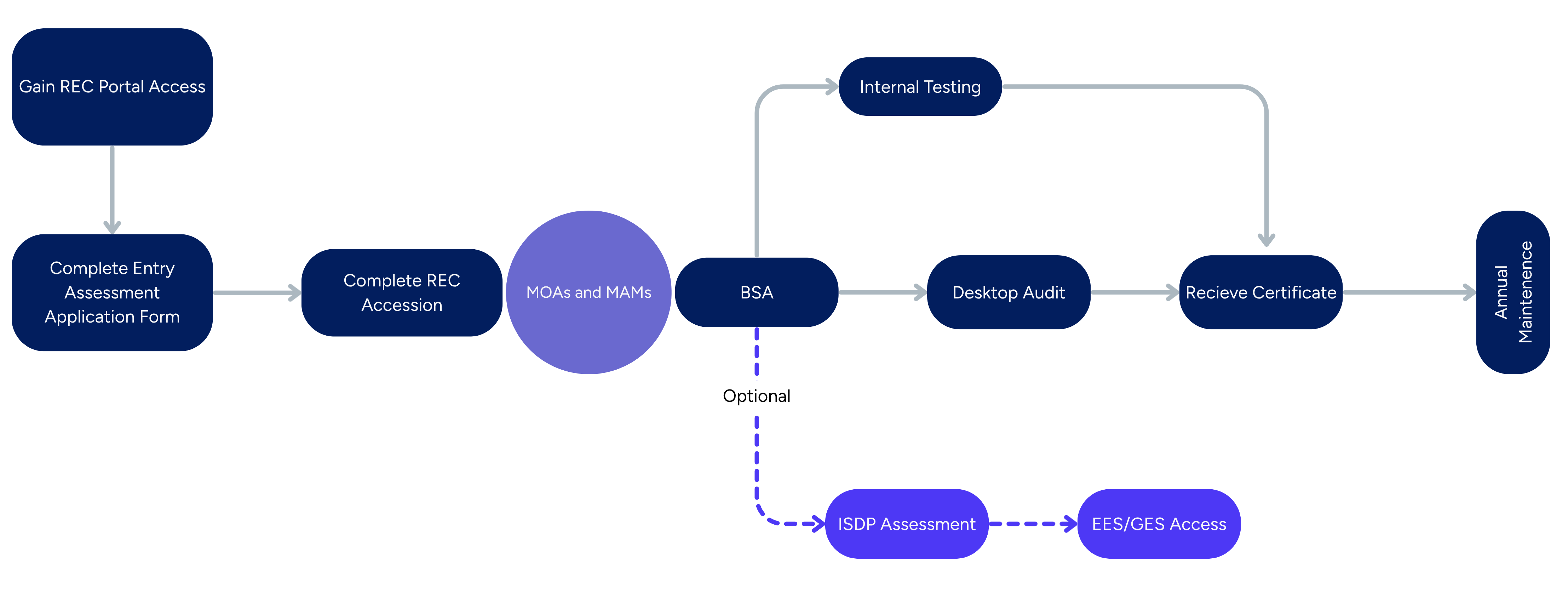
The process map for MOAs and MAMs is as follows:

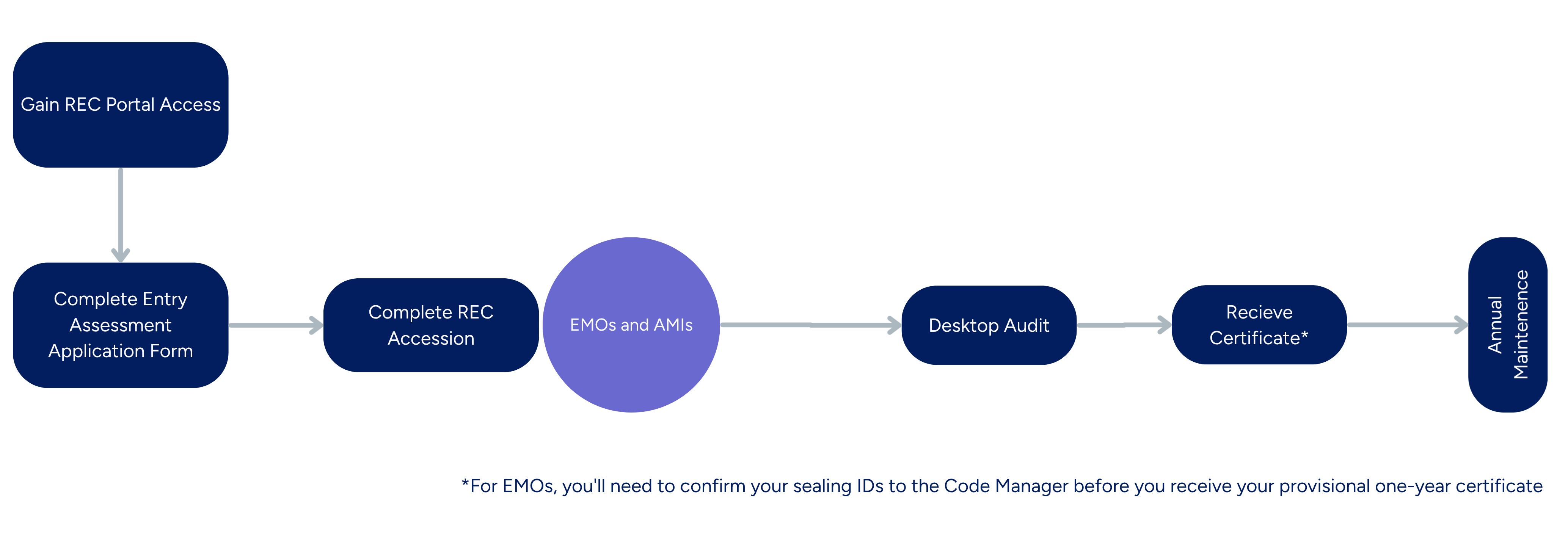
The process map for EMOs and AMIs is as follows:
There is separate guidance available for Safe Isolation Provider (SIP) applications at Safe Isolation Provider (SIP) - Metering - REC Portal.
Business Solution Assessment (MOA/MAM only)
The purpose of the Business Solution Assessment is to understand how you will ensure that you operate your business in-line with your obligations under the REC; the form will ask you to provide details and evidence of your business solution, comprising business processes, local work instructions, management procedures and IT applications.
You can access the forms at:
CoMCoP MOA Business Solution Assessment
CoMCoP MAM Business Solution Assessment
Internal Testing (MOA/MAM only)
The Internal Testing Assessment involves running tests to demonstrate your systems and process can operate against a defined list of market scenarios. The market scenarios you need to test will be defined using a risk-based approach depending on the answers to your BSA. You can find further information about internal testing in the Entry Assessment Information Pack.
Desktop Audit (all MOA/MAM/EMO/AMI)
The purpose of the audit is to understand that you have appropriate documentation and processes in place to ensure you perform metering work safely, and that you will be able to meet your obligations under CoMCoP.
The expected timeframe for the audit is as follows:
| Time (WDs from submission) | Responsible Party | Action | Notes |
| D-60 to D-40 | Party | Receive and Pay Invoice | The Auditor will invoice for the audit between 8 and 12 weeks ahead of the target date; your audit date maybe agreed either during this time, or once payment has been received. The invoice must be paid within 30 days of being issued |
| D-15 | Auditor | Confirm Audit Date | The Auditor will confirm audit date, and which sections of CoMCoP will be audited. |
| D-15 to D-1 | Party | Complete Audit | The company collates the required evidence and emails it to the auditor. During this period the company may ask for clarification on requirements. |
| D | Auditor | Review Submission | At 5pm on D-1, the evidence window for the initial submission is closed; no further evidence can be submitted or will be taken into account. Where the auditor has questions or evidence is insufficient, a list of additional questions will be drafted and sent to the company. For the avoidance of doubt, no communication shall take place between the auditor and the company on the audit date. |
| D+6 | Party | Respond to Additional Questions | The company has 5 working days to respond to any questions the auditor raises, and can seek further clarification in this time. |
| D+6 | Auditor | Review Submission | At 5pm on D+5, the response window for the additional questions is closed. The auditor will complete their review. |
| D+12 | Auditor | Provide Initial Report | The auditor will provide the party with any minor or major findings and any further instructions. |
| D+22 | Party | Respond to Initial Report | Within 10 working days the party should advise the auditor of how they plan to address the findings. |
| D+22 | Code Manager | Publish Certificate | If the Initial Report is a compliant audit, the RECCo will upload a CoMCoP Certificate to the Party’s REC Portal page. |
| D+~42 | Party | Close Minor Findings | The Auditor will set a date for each of the findings to be resolved; companies may extend this deadline by agreement. If the finding isn’t resolved, the auditor may recommend that the accreditation is revoked. |
| D+~62 | Party | Close Major Findings | As above |
| D + 1 year | Party | Ongoing Audits | The Party will complete a review audit with the Auditor, which includes both a site and desktop audit, 1 year after initial accreditation.
The Party will then complete a renewal audit with the Auditor, which includes both a site and desktop audit, every two years thereafter.
The Auditor will write to relevant Parties by the end of November with any target audit dates for the next year. |
You can find example Desktop Audit questions for:
MOA, MAM, EMO, AMI, MOA&EMO, MAM&AMI, ASP, SMI (Suppliers only).
REC Service User Documents
The use of a REC Service, particularly the Electricity Enquiry Service (EES) is different depending on the organisation. There are a series of EES User Guides for: Suppliers, Distributors, MEMs, Third Parties and Non-Domestic Consumers. These documents provide helpful insight into how EES works and contain a series of FAQs.
Non-Party REC Service User Assessment Forms
The entry assessment process for a Non-Party REC Service User is different to the process of a REC Party, as the assessment is focused on their ability to securely process the customer data they could access.
The ISDP is the main stage in the process. It is the assessment the Information Security Environment of the applicant. This has to be completed before an entrant can get access to the Energy Enquiry Services. It should also be filled out using the Entry Assessment Forms document. The ISDP can be found on the REC Portal here.
Controlled Market Entry
Once a Party has completed the different stages of the Entry Assessment process they enter into ‘Controlled Market Entry’, where the Code Manager can determine conditions that are temporarily placed on new entrants. These vary based on the nature of the business, their performance in the entry assessment process and their growth plans. These can include limits on customer registrations.
Please see the Controlled Market Entry Self-Assessment Form, which should be submitted to RECCo with the relevant supporting evidence, to allow a Party to exit from CMEC. This document requires the applicant to self-certify that they have successfully proved their operational capability. Guidance around the questions asked, how to respond and what evidence is required is also in the Entry Assessment Forms document. The Code Manager will review the form and seek evidence that the applicant can operate in accordance with the REC requirements. This will typically focus on performance in the market to date. Once completed, the Code Manager will advise the Party of its conclusions, prior to sharing these with the Performance Assurance Board (PAB).